Handheld Transceivers (HTs) — Where Everyone Starts
Handheld radios run on internal batteries and output 4–8 watts. They are perfect for: getting started, portable/hiking operation, emergency go-kits, and any situation where you need a self-contained radio that goes wherever you go. The limitation is physics: a 5-watt radio with a small rubber duck antenna has limited range, especially from inside a vehicle or building where RF absorption is high.
What a Mobile Radio Changes
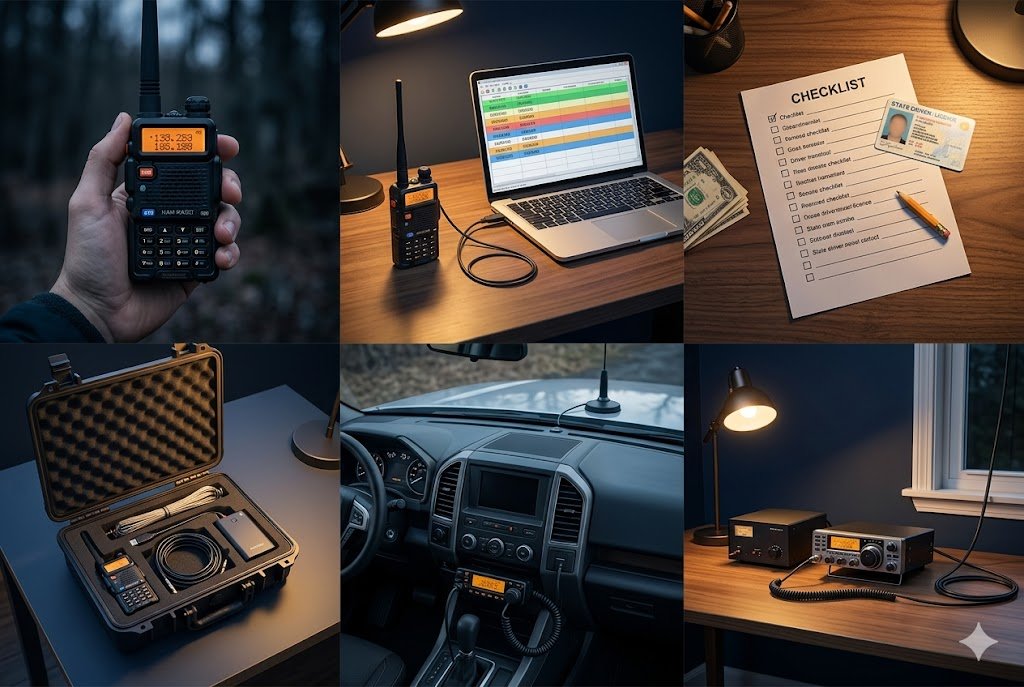
Mobile radios mount in vehicles and draw power from the car's 12-volt electrical system. Standard output power is 25–65 watts on VHF/UHF — roughly 5–13 times more than an HT. Combined with a proper external antenna (magnetic mount or fixed mount on the vehicle), range increases dramatically. A 50-watt mobile with a well-positioned antenna routinely hits repeaters 40–80 miles away. Your HT might reach the same repeater from 5 miles away.
The Antenna Factor
More power alone does not explain all of the range difference. The larger, properly tuned external antenna of a mobile installation is equally important. A mobile station with a good 5/8-wave vertical antenna at roof height outperforms an HT with a rubber duck antenna even at the same power level. The antenna is often the bigger upgrade.
When to Make the Move
Consider a mobile radio when: you find yourself frustrated that your HT cannot consistently reach repeaters from your vehicle, you want reliable statewide or regional range, you spend significant time commuting and want clear contacts while driving, or you are participating in emergency communications where reliable coverage matters. Common entry-level dual-band mobiles: Yaesu FT-7900R (~$200), Kenwood TM-V71A (~$280), Icom IC-2730A (~$250).
Mobile Radio as a Home Base Station
A mobile radio plus a regulated 13.8V DC power supply functions perfectly as a home base station — no separate "base station" radio needed. Add an outdoor vertical antenna (Diamond X50A or similar) and you have a capable home station for well under $400 total.
- Can I use a mobile radio without mounting it permanently in my vehicle?Yes. Many hams run "rover" setups with a mobile radio and magnetic mount antenna that they move between vehicles or use temporarily. A simple 12V power adapter for the cigarette lighter socket provides power without permanent wiring. For full 50-watt output, a direct connection to the vehicle battery is recommended — lighter socket adapters often cannot supply enough current for high-power operation.
- Do I need to upgrade my HT before getting a General Class license?No. Your license class is independent of your equipment. A Technician with a General license can operate a sophisticated HF station; a General with an HT is limited by the radio's capabilities, not their license. Equipment decisions are separate from licensing decisions.
Informational only. Verify current rules at fcc.gov and arrl.org. Not affiliated with the FCC, ARRL, or any VEC.