What Is a Go-Kit?
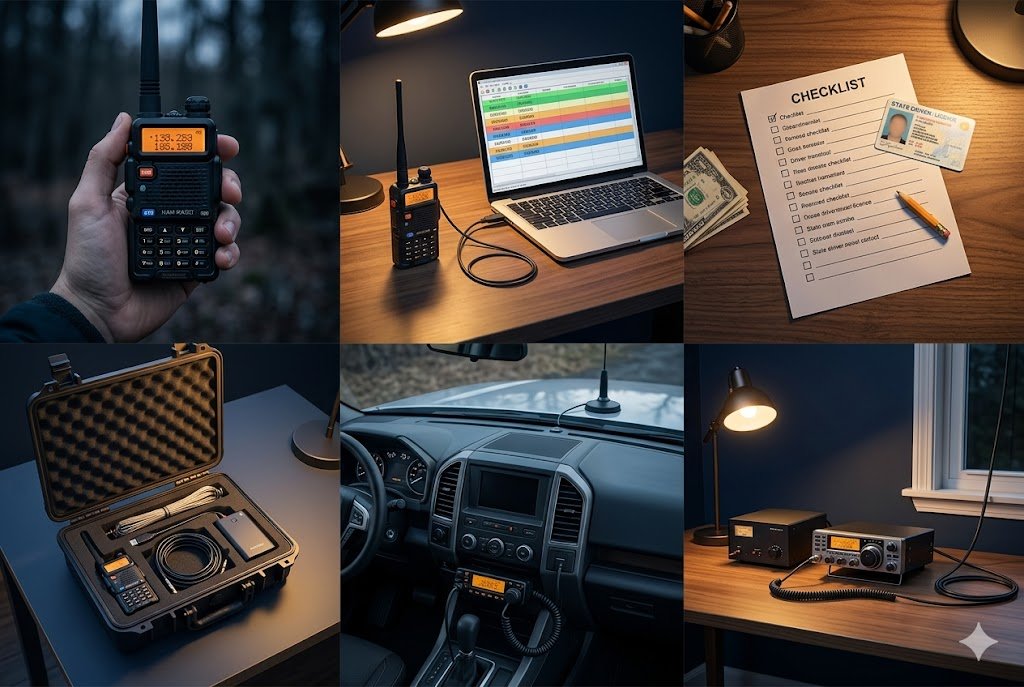
A go-kit is a portable, self-contained amateur radio station designed for rapid deployment — at an emergency shelter, public service event, field day site, or any location where you need to operate away from your home station. The key attributes: everything fits in one bag or case, powers from battery without AC, and can be set up in under five minutes.
Go-kits are required equipment for ARES (Amateur Radio Emergency Service) participation and are strongly recommended for any ham interested in emergency preparedness. Even if you never activate for a disaster, a go-kit is simply the best way to operate portable.
The Core Components
Radio
A dual-band HT (handheld transceiver) is the minimum. A Baofeng UV-5R or Yaesu FT-65R covers 2 meters and 70 centimeters — the two primary bands for local emergency nets. For more range, a small mobile radio like the Yaesu FT-7900R in a case with a 12V battery provides 50 watts and dramatically better coverage.
Power
Two options for portable power: (1) LiFePO4 battery — a 20Ah lithium iron phosphate battery ($80–$120) powers a mobile radio for 4–8 hours of mixed transmit/receive. Lighter than lead-acid, more charge cycles, safe to transport. (2) Marine deep-cycle SLA — heavier but cheaper ($40–$60 for a 12Ah battery). Either connects to a mobile radio via Anderson Powerpole connectors.
For HT-only go-kits, a 10,000–20,000 mAh USB power bank with a 12V boost cable charges the HT's battery on the go. Carry two fully charged HT batteries.
Antenna
Do not rely on the HT's rubber duck for emergency deployment. Include at least one of: a roll-up J-pole antenna (deploys on any fence post or tree branch, $20–$40), a telescoping whip on a suction cup window mount, or a small magnetic mount antenna for vehicle operation. The antenna makes the biggest difference in coverage — a good portable antenna turns a 5-watt HT into a station that can reach repeaters 20+ miles away.
Power Connectors and Cables
Anderson Powerpole connectors are the ARES standard for all DC connections. Wire your battery, radio, and any accessories with Powerpoles so any component connects to any other without adapters. A Powerpole distribution block ($15) lets you run multiple devices from one battery.
Complete Technician-Level Go-Kit — Under $200
| Item | Approx. Cost |
|---|---|
| Baofeng UV-5R + extra battery + car adapter | $35 |
| Nagoya NA-771 aftermarket HT antenna | $13 |
| Roll-up J-pole antenna (2m/70cm) | $30 |
| 20,000 mAh USB power bank (w/ 12V output) | $40 |
| Programming cable + laptop-ready CHIRP USB | $12 |
| Waterproof hard case (Pelican-style) | $35 |
| Notepad, pens, frequency reference card (printed from this site) | $5 |
| Coax jumper, PL-259 adapters, Powerpole connectors | $20 |
| Total | ~$190 |
Organization and the "5-Minute Rule"
A good go-kit deploys in five minutes without hunting for anything. Every item has a designated pocket or compartment. Label cables with the devices they connect to. Keep a laminated checklist inside the case lid — verify the list every time you repack, not just when you need it urgently.
Test your go-kit at least quarterly: take it to a local park, set it up from scratch, make at least one contact, and note what was missing or inconvenient. The test run before a real activation reveals problems that are easy to fix at home.
- Do I need a go-kit to participate in ARES?ARES does not mandate a specific go-kit, but most served agencies expect operators to bring their own equipment and power. An operator who arrives at a shelter without a working radio and power supply cannot be useful. Building a basic go-kit before joining your first activation is strongly recommended.
- Can I fly with a ham radio go-kit?The radio itself is fine in carry-on or checked luggage. LiFePO4 batteries under 100Wh are permitted in carry-on only (not checked) per TSA and IATA rules — check your airline's specific policy. Lead-acid batteries are prohibited on commercial flights entirely. A 20Ah LiFePO4 at 12V = 240Wh, which typically requires airline approval and may not be permitted. For air travel, a smaller battery (under 100Wh) or shipping the kit ahead is the practical solution.
- What is an Anderson Powerpole and why does everyone use them?Anderson Powerpole connectors are genderless, color-coded (red/black) DC connectors that have become the amateur radio standard for portable power. They are rated 30A or 45A, connect in any orientation, and allow any device to connect to any power source without polarity confusion. ARES groups standardize on Powerpoles so that any operator's equipment works with any group's power infrastructure during activations.
Informational only. Verify current rules at fcc.gov and arrl.org. Not affiliated with the FCC, ARRL, or any VEC.